 info@seoquartz.co
 +1 (276) 739-9962

June 19, 2026
The Future of SEO in Washington: Ranking in AI-Powered Search Results-updated
A Seattle contractor told us something last month that stuck: his phone had gone quiet even though his Google rankings hadn’t moved. Position 3 for his main keyword, same as six months ago. Fewer calls.
What changed wasn’t his ranking. It was where the click used to be.
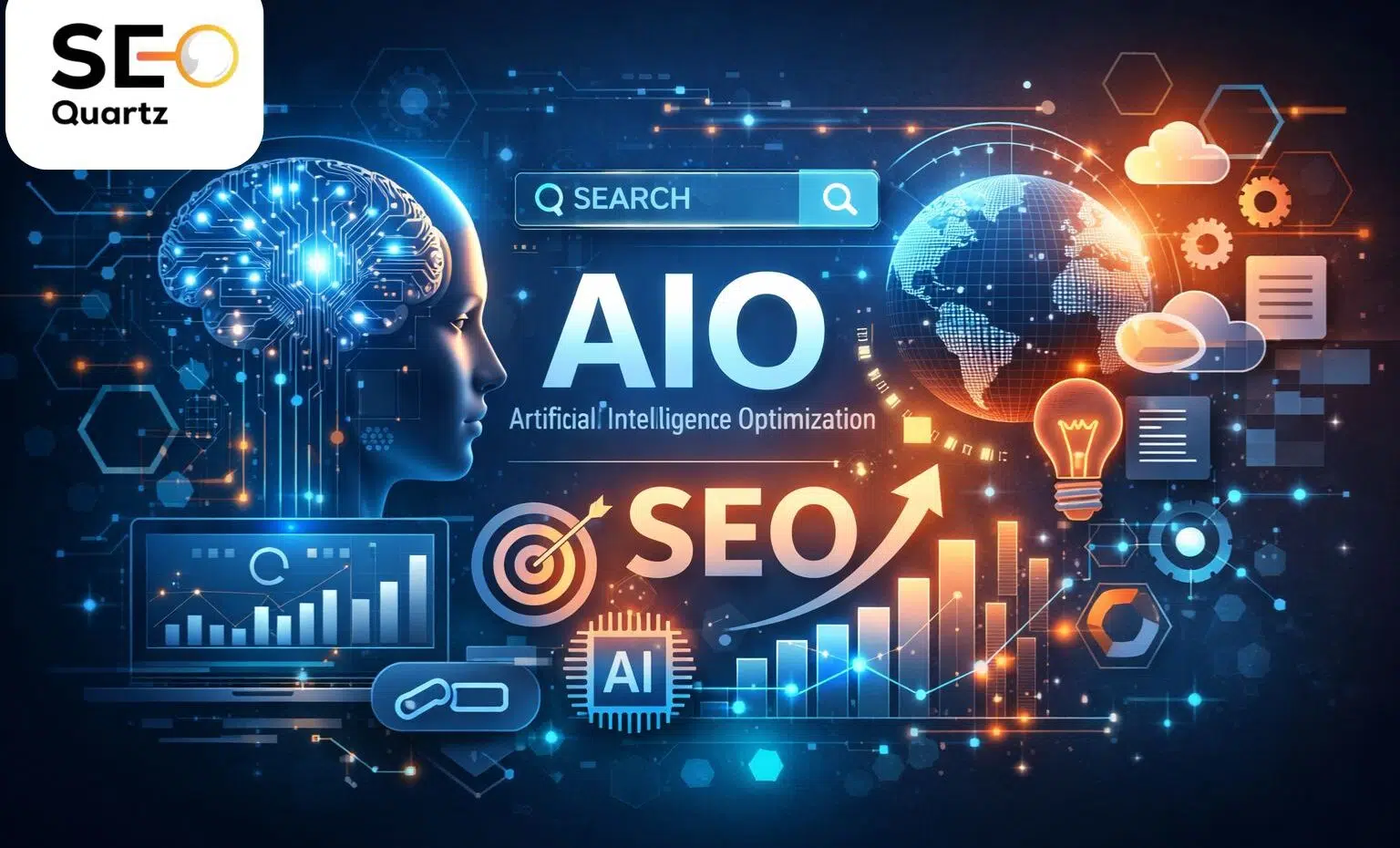
Search results in Washington now routinely open with an AI-generated summary before a single blue link appears. Industry data puts AI Overviews on roughly half of all Google searches as of early 2026, and that share keeps climbing month over month. For a business that built its lead pipeline around ranking on page one, this is the ground shifting under a strategy that worked fine as recently as last year.
This isn’t a story about SEO dying. It’s a story about SEO splitting into two jobs at once: still earning a ranking, and now also earning a mention inside the answer itself. Businesses searching for SEO service in Washington today need both, and most local competitors are only doing the first one.
Here’s what’s actually happening on the results page now. A user searches for “best plumber in Tacoma” or “Seattle accounting firm for small business.” Google generates a synthesized answer pulling from multiple sources, often naming two or three businesses by name, before any organic listing loads below the fold.
If your business isn’t one of the names mentioned in that summary, you’re invisible at the exact moment someone was ready to act. Ranking #4 doesn’t matter if the AI Overview already answers the question and the user never scrolls.
The data backs up what many business owners are experiencing. Several 2026 studies report organic click-through rates on AI Overview queries dropping significantly compared to traditional search results. At the same time, brands cited within AI-generated answers often receive stronger engagement and brand recall.
| Factor | Traditional SEO | AI Search Optimization |
| Primary Goal | Rank higher in SERPs | Get cited in AI-generated answers |
| Success Metric | Rankings & Clicks | Citations, Mentions & Visibility |
| Content Style | Keyword-focused | Answer-focused |
| User Journey | Search → Click → Website | Search → AI Answer → Brand Discovery |
| Key Signals | Backlinks, Keywords | Authority, Structure, Expertise |
| Visibility Source | Organic Listings | AI Overviews, ChatGPT, Gemini, Perplexity |
| Optimization Focus | Rankings | Rankings + Citations |
This shift means businesses investing in SEO Service in Washington must now optimize for both rankings and AI citations rather than focusing exclusively on traditional search positions.
Most Washington businesses haven’t touched their content strategy to account for any of this yet. That gap is the opportunity.
AI systems don’t reward the same things classic SEO rewarded. They favor content with a clear, direct answer near the top, specific data points, and a structure that’s easy to extract and quote. A page that buries the answer under three paragraphs of throat-clearing loses to a page that states the answer in the first two sentences, even if the second page has thinner overall content.
This means a business willing to restructure its existing pages not necessarily write more, but write differently can pick up citation visibility that competitors with objectively stronger domain authority haven’t claimed yet. One Ahrefs analysis found that roughly 80% of URLs cited across ChatGPT, Perplexity, Copilot, and Google’s AI Mode don’t even rank in the top 100 organic results for the same query. Citation and ranking are no longer the same race.
For a Washington business, that’s a genuine opening. A well-structured FAQ page answering “how much does SEO cost in Seattle” can get pulled into an AI answer even while sitting outside the top 50 organic results, simply because the format is built for extraction.
The second gain is durability. Citations inside AI answers tend to draw from sources the model judges as established and consistent earned mentions, structured data, a track record of being referenced elsewhere. Building that now, while most local competitors are ignoring it, compounds. Catching up later costs more than starting early.
A few shifts are visible right now, not theoretical ones a year out.
AI systems are designed to extract clear, structured, and trustworthy information. Businesses that publish organized content have a higher chance of appearing in AI-generated answers.
| Content Type | Citation Likelihood |
| Structured FAQ Pages | 92% |
| Detailed Service Guides | 85% |
| Case Studies | 78% |
| Local Resource Pages | 72% |
| Generic Blog Posts | 48% |
| Keyword-Stuffed Pages | 21% |
This illustrates why Washington businesses should focus on creating content that directly answers user questions rather than publishing keyword-heavy pages designed solely for rankings.
Start with the content you already have rather than building new pages from scratch.
Pull your highest-traffic service pages and rewrite the opening two to three sentences to directly answer the core question a searcher would ask, before any setup or context. If the page is about SEO service in Washington, the first line should say what that service includes and who it’s for, not open with a story about the market.
Next, build a genuine FAQ section using real questions, not invented ones. Look at “People also ask” boxes, actual client questions from sales calls, and search suggestions for your core terms. Each answer should stand alone as a complete, citable paragraph two to four sentences, specific, no filler.
Add structured data. LocalBusiness, Service, and FAQPage schema give both traditional crawlers and AI systems a clean, machine-readable version of your content. This isn’t optional anymore; it’s table stakes for citation eligibility.
Build topical depth instead of isolated pages. A single page targeting “SEO services Washington” competes alone. A cluster on the main service page, supporting articles on local SEO mechanics, city-specific guides for Seattle and Spokane, pricing breakdowns, case studies gives AI systems multiple corroborating signals that your business is a legitimate authority on the topic, not a single page making a claim.
Finally, track citations, not just rankings. Search your business name directly in ChatGPT, Perplexity, and Google’s AI Mode periodically. If you’re not showing up for queries you’d expect to win, that’s a content gap worth investigating before a competitor fills it.
The most common mistake is treating AI search optimization as a one-time content update rather than a structural shift in how content gets written going forward. A business fixes one page, sees no immediate change, and abandons the approach. Citation visibility builds over months, the same way traditional authority did.
A close second: writing for AI systems by stuffing in keyword variations rather than clarity. AI extraction tools penalize exactly what old-school SEO used to reward repetition and density. A page trying to hit fifteen keyword variants of “SEO Washington” reads worse to both humans and language models than one that answers the question plainly once and moves on.
Many businesses also ignore the platforms outside Google entirely. A site that’s been optimized carefully for Google AI Overviews but never considered how ChatGPT or Perplexity parse and cite content is only solving part of the problem, especially given how differently each platform sources its answers.
There’s also a trust gap. Businesses sometimes publish thin, generic local pages a city name swapped into an otherwise identical template assuming volume of pages beats depth. AI systems, like increasingly sophisticated search algorithms, recognize this pattern and tend to deprioritize it in favor of pages with genuine, specific local substance.
Last, plenty of businesses still measure success purely by click volume, missing that brand mentions inside AI answers even without a click build, the kind of recognition that shows up later as a direct, branded search or a phone call from someone who “saw your name come up.”
The businesses earning visibility in AI-powered search are focusing on authority, structure, and local relevance.
| Priority | Impact on AI Search | Business Value |
| FAQ Optimization | Very High | More AI citations |
| Local Business Schema | Very High | Better local visibility |
| Google Business Profile | High | Local lead generation |
| Expert-Led Content | Very High | Authority building |
| Case Studies | High | Trust and conversions |
| Reviews & Reputation | High | Local rankings and credibility |
| Voice Search Optimization | Medium-High | Future-proof visibility |
| AI Search Monitoring | High | Track mentions across platforms |
Businesses that prioritize these areas are better positioned to gain visibility across Google AI Overviews, ChatGPT, Gemini, Perplexity, and future AI-powered search platforms.
The next eighteen months will likely bring tighter integration between AI answers and local business data. Expect AI systems to pull more directly from Google Business Profiles, verified review platforms, and structured local data rather than relying solely on web content. Businesses with clean, complete, consistent local data across every platform will have a real head start once that shift accelerates.
Voice and conversational search will keep growing alongside this. Someone asking a smart speaker or an AI assistant “who’s a good SEO company near Seattle” needs an answer built from the same structured, direct content that wins AI Overview citations today. The two trends are converging, not competing.
Expect AI platforms to keep diverging in how they source answers, which means businesses serious about visibility will need a presence built for extraction across multiple systems, not a single optimized target. The businesses treating this as one more checkbox on a traditional SEO list will fall behind the ones treating it as its own discipline.
SEO Quartz helps businesses adapt to the next generation of search visibility.
Our team develops strategies designed for both traditional search engines and emerging AI-powered platforms. We focus on creating authority-driven content, strengthening local presence, optimizing technical performance, and building digital trust signals that influence modern search algorithms.
Unlike agencies that focus only on rankings, SEO Quartz helps businesses increase visibility where customers are actually searching, whether that’s Google, AI Overviews, ChatGPT, Gemini, Perplexity, or voice assistants.
Our approach combines local SEO expertise, content strategy, technical optimization, and AI search readiness to deliver measurable results for businesses throughout Washington.
The businesses adapting fastest in Washington right now aren’t necessarily the ones with the biggest budgets. They’re the ones willing to rewrite a service page so it answers a question in the first sentence instead of the fourth paragraph, and to treat AI citation as something worth measuring alongside rank.
SEO service in Washington, done well in 2026, means showing up in both places the ranked result and the generated answer above it. Most local competitors are still only building for one of them. That gap won’t stay open forever, but it’s open right now.
Does ranking #1 on Google still matters if AI Overviews are taking the clicks?
Yes, but it’s no longer sufficient on its own. Ranking strongly still feeds AI systems that pull from organic results, and it still wins clicks on the roughly half of searches that don’t trigger an AI Overview. The change is that ranking alone no longer guarantees visibility on the other half.
How is GEO different from traditional SEO?
Traditional SEO optimizes primarily for ranking position. GEO (Generative Engine Optimization) optimizes for being extracted, summarized, and cited inside an AI-generated answer which depends more on direct, scannable answer structure than on backlink volume or keyword density.
Can a small local business actually get cited in ChatGPT or Google AI Mode?
Yes. Citation in AI search depends more on content clarity and structure than on domain size or authority alone. A well-built FAQ page or service guide from a small Washington business can outperform a much larger competitor’s unstructured content for citation purposes.
Do I need separate content for Google AI Overviews versus ChatGPT or Perplexity?
Not entirely separate, but each platform sources differently, so a single piece of well-structured, fact-dense, clearly headed content tends to perform across all of them better than content built narrowly for one search engine’s traditional ranking algorithm.
How long does it take to see results from AI search optimization?
Similar to traditional SEO, expect a few months before consistent citation patterns emerge, though some well-structured FAQ-style updates have shown faster individual results since they directly match how AI systems extract answers.
Is schema markup actually necessary, or is that outdated advice?
It’s more necessary now than it was three years ago, not less. Structured data gives both crawlers and AI systems a clean, unambiguous read of your business details, which directly affects citation eligibility in local and service-based queries.
What’s the single highest-impact change a Washington business can make this year?
Rewrite your core service pages so the first two sentences directly answer the question a searcher would ask, before any other context. It’s the fastest, lowest-cost change with the most direct effect on AI extraction and citation.